

Healthcare imaging environments are rapidly becoming more complex.
More imaging volume, systems, locations, and vendors.
More pressure to scale without disrupting core clinical operations.
For many healthcare organizations, the real issue is orchestrating workflows across expanded enterprise environments while ensuring visibility, reliability, and operational control. This is precisely where enterprise imaging workflow orchestration becomes crucial, working with intelligent DICOM routing to keep operations synchronized.
Moving Beyond Traditional DICOM Routing
Traditional DICOM routing platforms were built for a different era of healthcare IT.
Today’s imaging demands more than simple point-to-point routing. Organizations must manage:
-
Multi-site imaging networks
-
Hybrid cloud environments
-
PACS consolidations
-
Vendor transitions
-
Teleradiology workflows
-
Enterprise standardization initiatives
-
Large-scale migration projects
-
Increasing interoperability requirements
As imaging ecosystems grow, static routing and fragmented workflows hinder scalability. Even advanced DICOM routers solve only part of the problem without enterprise-grade orchestration. Healthcare needs centralized orchestration—intelligent, cohesive, enterprise-wide workflow coordination.
The Rise of Workflow Orchestration in Enterprise Imaging
Enterprise imaging workflow orchestration delivers a smarter, scalable approach to managing imaging operations.
Orchestration goes beyond routing, enabling organizations to:
-
Centralize workflow management.
-
Automate imaging operations.
-
Improve visibility across systems.
-
Scale infrastructure more efficiently.
-
Balance workloads across environments.
-
Standardize workflows across locations.
-
Reduce operational bottlenecks.
-
Maintain high availability in mission-critical environments.
Data movement is not the end goal.
Operational intelligence is the goal.
Why Integrated HL7 + DICOM Matters
One of the biggest shifts occurring in enterprise imaging is the growing need to unify imaging workflows with broader healthcare interoperability requirements.
DICOM alone is no longer enough.
Organizations increasingly require integrated HL7 capabilities that allow imaging operations to coordinate more effectively with RIS, EMR, EHR, scheduling systems, and enterprise workflows.
Combining DICOM routing with HL7 integration creates an infrastructure for modern, scalable operations.
This becomes especially important during:
-
PACS replacements
-
Hospital acquisitions
-
Enterprise consolidations
-
Multi-vendor integrations
-
Workflow modernization initiatives
-
Large-scale migration projects
Enterprise Reliability Is No Longer Optional
Imaging operations are now mission-critical.
Downtime and routing failures disrupt entire healthcare systems.
That is why healthcare organizations are prioritizing:
-
High availability architectures
-
Centralized workflow visibility
-
Policy-driven automation
-
Deterministic routing
-
Enterprise governance
-
Scalable infrastructure design
Operational realities require workflow orchestration platforms designed for enterprise demands.
The Bigger Industry Shift
Healthcare imaging moves toward centralization, orchestration, and interoperability. As organizations scale imaging operations, modernize infrastructure, and consolidate systems, workflow orchestration becomes a foundational element of enterprise imaging strategy.
Routing images is not enough.
The aim: Intelligent, resilient, scalable imaging ecosystems that advance healthcare.
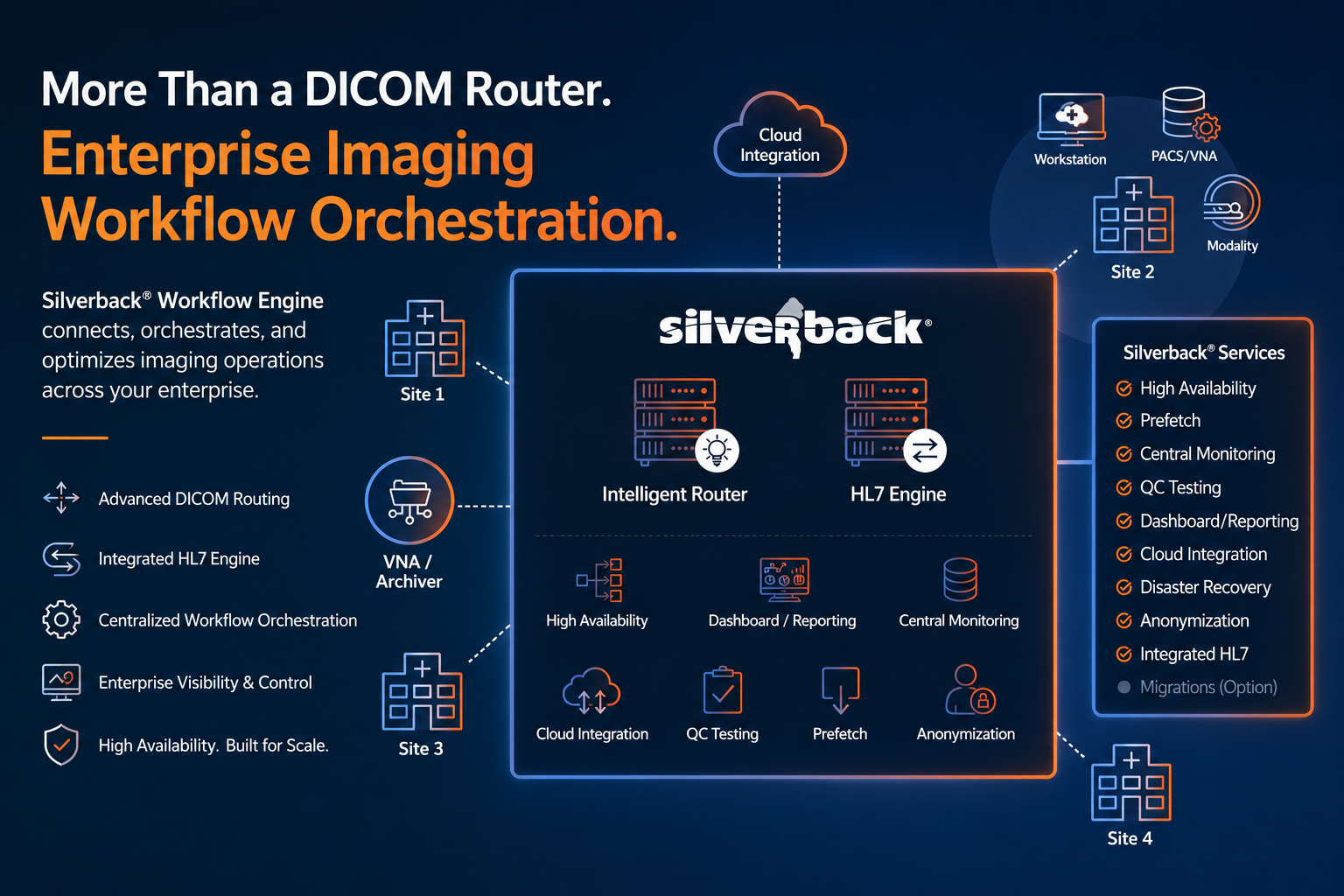
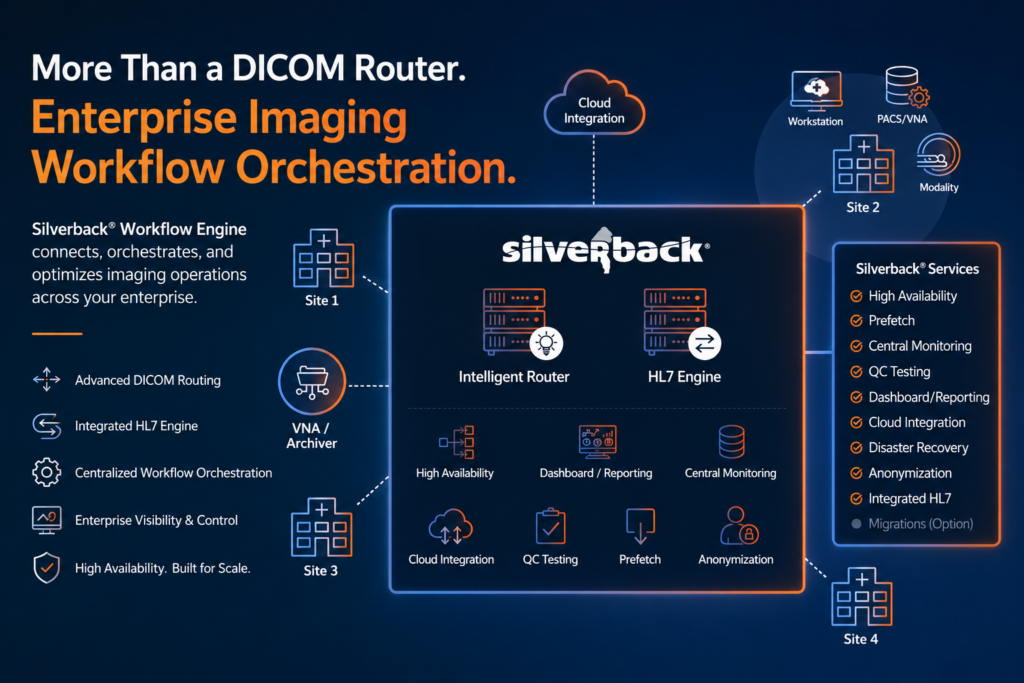
At DataFirst, this is the vision behind the Silverback® Workflow Engine: Integrating advanced DICOM routing, workflow orchestration, and an HL7 engine into a platform built for real-world enterprise imaging environments.
The future of enterprise imaging is not simply connected.
It is orchestrated.
Frequently Asked Questions
Question: What does workflow orchestration add that traditional DICOM routing does not?
Short answer: Traditional DICOM routing primarily moves images from point A to point B. Workflow orchestration goes further by coordinating end-to-end imaging operations across sites, vendors, and environments. It centralizes workflow management, automates tasks, provides enterprise-wide visibility, balances workloads, standardizes processes across locations, reduces bottlenecks, and maintains high availability. In short, routing moves data; orchestration delivers coordinated operational intelligence at scale.
Question: When is integrating HL7 with DICOM especially important?
Short answer: HL7 + DICOM integration becomes critical when imaging needs to align tightly with broader clinical and operational systems such as RIS, EMR/EHR, and scheduling. It is particularly important during:
-
PACS replacements and vendor transitions
-
Hospital acquisitions and enterprise consolidations
-
Multi-vendor integrations and standardization initiatives
-
Large-scale migration projects and workflow modernization. This integration keeps imaging workflows in sync with enterprise data and processes as organizations scale.
Question: What challenges make workflow orchestration necessary in today’s imaging environments?
Short answer: Growing complexity—more volume, systems, locations, and vendors—makes static routing and fragmented workflows hard to scale. Organizations are dealing with multi-site networks, hybrid cloud, teleradiology, consolidations, and increasing interoperability demands. Orchestration addresses these challenges by centralizing control, automating operations, improving cross-system visibility, and enabling scalable, standardized workflows that work reliably across distributed environments.
Question: How does orchestration improve reliability and reduce operational risk?
Short answer: Imaging is mission-critical, so downtime or routing failures can ripple across the enterprise. Orchestration platforms support high availability architectures, centralized workflow visibility, policy-driven automation, deterministic routing, enterprise governance, and scalable design. Together, these features reduce disruptions, surface issues quickly, and keep data and workflows accessible even under real-world operational pressures.
Question: How does DataFirst’s Silverback® Workflow Engine fit into this shift?
Short answer: Silverback® delivers enterprise-grade imaging orchestration, integrating intelligent DICOM routing, workflow management, and HL7 support into a single platform. Designed for real-world healthcare environments, Silverback® is engineered to create resilient, scalable, and coordinated imaging ecosystems that meet the demands of modern delivery.
Want to see Silverback® in action? Be sure to schedule your meeting or demo today!