
Enterprise Imaging Workflow Orchestration
Overview
What is Enterprise Imaging Workflow Orchestration?
Enterprise imaging workflow orchestration is the centralized management and automation of imaging data movement across healthcare systems.
Rather than relying solely on traditional DICOM routers, workflow orchestration platforms like the Silverback® Workflow Engine apply rules, logic, and automation to ensure imaging studies are routed, processed, and delivered efficiently across enterprise imaging environments.
Workflow orchestration enables healthcare organizations to:
- Automate imaging data routing
- Balance workloads across reading environments
- Prefetch studies before interpretation
- Integrate imaging workflows with HL7 systems
- Support multi-PACS architectures
- Enable scalable growth across imaging networks
The Silverback® Workflow Engine
The Silverback® Workflow Engine provides an intelligent orchestration layer for enterprise imaging environments.Rather than acting as a simple router, Silverback® orchestrates imaging workflows across systems, enabling automation, visibility, and scalable data movement.
Silverback® integrates with:
- PACS systems
- Vendor Neutral Archives (VNA)
- Imaging modalities
- Radiology Information Systems (RIS)
- HL7 interfaces
- Teleradiology platforms
- AI imaging applications
This unified orchestration layer allows healthcare organizations to modernize imaging infrastructure without disrupting clinical workflows.
The Silverback® Workflow Engine
The Challenge
Radiology departments and imaging networks often operate across highly complex environments.
Common challenges include:
Fragmented Imaging Infrastructure
Many healthcare organizations operate multiple PACS systems across hospitals, outpatient centers, and imaging networks.
Rapid Imaging Volume Growth
As imaging utilization grows, systems must process significantly larger volumes of studies and data.
Distributed Reading Environments
Teleradiology and multi-site reading environments require intelligent routing of studies to the appropriate radiologist.
Mergers and Acquisitions
Healthcare consolidation frequently introduces new systems, vendors, and workflows into imaging environments.
Increasing Dataset Size
Advanced modalities such as mammography, CT, and digital pathology produce increasingly large datasets that strain traditional routing infrastructure.
Key Capabilities
Advanced DICOM Routing
Highly configurable DICOM routing designed for complex enterprise imaging environments.
Capabilities include:
- Rule-based study routing
- Conditional routing logic
- Multi-destination routing
- Intelligent routing across imaging networks
- Study lifecycle management
Workflow Automation
Manual workflow processes create operational bottlenecks. Silverback® automates critical processes including:
Automates:
- Study distribution to reading groups
- Automated routing rules
- Study lifecycle management
- Workflow-based routing logic
HL7 Integration
Imaging workflows depend on integration with clinical systems. Silverback® includes an integrated HL7 interface engine supporting:
Supports:
- Patient demographic workflows
- Order-based routing logic
- RIS integration
- Cross-system workflow coordination
Prefetch Automation
Radiologists require access to prior studies before interpreting new exams. Silverback® automates retrieval from PACS or archive systems before interpretation.
Benefits:
- Faster radiologist workflows
- Improved diagnostic context
- Reduced manual intervention
High Availability Architecture
Enterprise imaging must maintain continuous availability. Silverback® supports highly resilient architectures for mission-critical environments.
Features:
- Failover routing
- Redundant processing nodes
- Continuous workflow operation
- Enterprise-level reliability
Imaging Data Migration Tools
Healthcare organizations frequently migrate imaging data during upgrades or PACS transitions. Silverback® includes built-in tools supporting:
- PACS migrations
- Imaging archive consolidation
- System replacements
- Legacy system retirements
Use Cases for Workflow Orchestration
01 — Multi-PACS
Multi-PACS Environments
Many healthcare organizations operate multiple PACS systems across facilities.
Silverback® enables centralized routing and workflow control across distributed PACS environments.
02 — Radiology
Radiology Operations
Radiology departments and high-volume teleradiology operations require deterministic routing to the appropriate reading radiologist.
Silverback® enables automated study distribution, workload balancing, and intelligent routing across complex imaging workflows.
03 — Expansion
Healthcare System Expansion
As organizations acquire new facilities or expand imaging services, workflow orchestration enables rapid integration of new imaging systems.
Silverback® Workflow Engine accelerates expansion by integrating newly acquired imaging systems into a unified workflow — reducing onboarding time and ensuring consistent performance across the enterprise.
04 — AI
Imaging AI Integration
AI applications increasingly require imaging data routed to specialized processing platforms.
Silverback® enables seamless routing of imaging studies to AI workflows while maintaining clinical system integration.
Enterprise Architecture
Where Silverback® Fits in the Enterprise Imaging Architecture
DataFirst provides enterprise imaging workflow orchestration that enables advanced DICOM routing, large-scale PACS migration, and centralized control of imaging data across multi-vendor healthcare environments.
Healthcare organizations rely on DataFirst to modernize imaging infrastructure while maintaining clinical continuity and operational stability.
Organizations use DataFirst to:
- Orchestrate imaging workflows across multiple PACS and VNAs
- Execute complex imaging data migrations without clinical downtime
- Retain ownership, visibility, and governance of imaging data
- Reduce operational risk and manual workflow intervention
- Prepare enterprise imaging infrastructure for AI and advanced analytics
- Modernize imaging infrastructure
- Scalable imaging data management
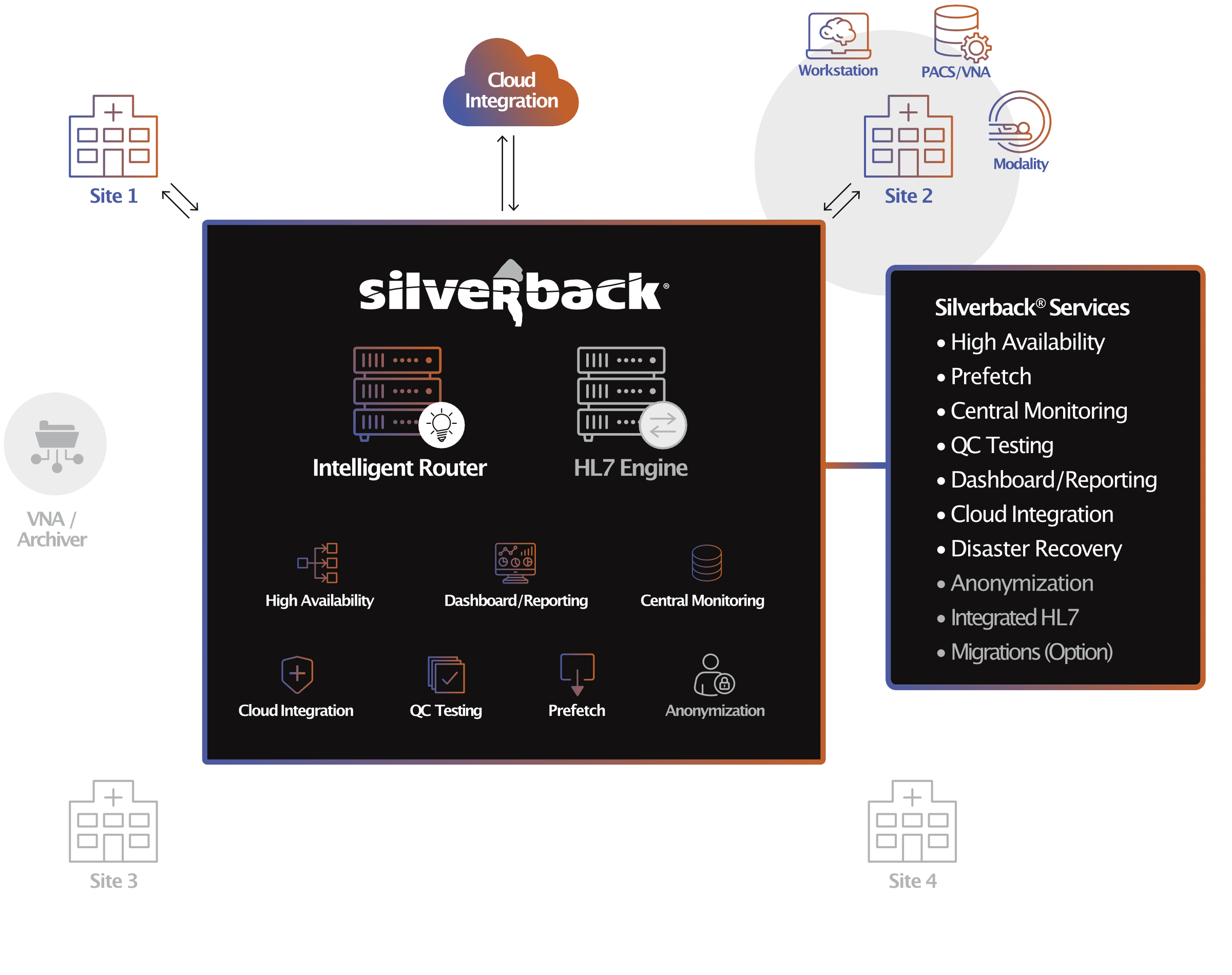
Callout
Silverback® acts as the orchestration layer between imaging infrastructure and clinical workflow systems.
Enterprise imaging environments consist of multiple interconnected systems including imaging modalities, PACS, VNAs, cloud archives, AI applications, and radiology reading platforms.
The Silverback® Workflow Engine provides a centralized orchestration layer that governs how imaging data moves across this ecosystem — ensuring deterministic routing, workflow automation, and operational visibility across the enterprise imaging infrastructure.
Key Capabilities
Advanced DICOM Routing
Silverback® provides highly configurable DICOM routing designed for complex enterprise imaging environments.
Capabilities include:
- Rule-based study routing
- Conditional routing logic
- Multi-destination routing
- Intelligent routing across imaging networks
- Study lifecycle management
This enables organizations to control precisely how imaging studies move across systems.
Workflow Automation
Manual workflow processes can create operational bottlenecks in imaging environments.
Silverback® automates critical processes, including:
- Study distribution to reading groups
- Automated routing rules
- Study lifecycle management
- Workflow-based routing logic
Automation reduces operational overhead while improving consistency and reliability.
HL7 Integration
Imaging workflows often depend on integration with clinical systems.
Silverback® includes an integrated HL7 interface engine capable of supporting:
- Patient demographic workflows
- Order-based routing logic
- RIS integration
- Cross-system workflow coordination
This allows imaging workflows to align with broader clinical data systems.
Prefetch Automation
Radiologists often require access to prior studies before interpreting new exams.
Silverback® automates prefetch workflows by retrieving prior imaging studies from PACS or archive systems before interpretation.
Benefits include:
- Faster radiologist workflows
- Improved diagnostic context
- Reduced manual intervention
High Availability Architecture
Enterprise imaging infrastructure must maintain continuous availability.
Silverback® supports highly resilient architectures designed for mission-critical environments.
Features include:
- Failover routing
- Redundant processing nodes
- Continuous workflow operation
- Enterprise-level reliability
Imaging Data Migration Tools
Healthcare organizations frequently need to migrate imaging data during system upgrades or PACS transitions.
Silverback® includes built-in tools designed to support:
- PACS migrations
• imaging archive consolidation
• system replacements
• legacy system retirements
For more than 25 years, DataFirst has moved billions of imaging studies through complex PACS and archive migrations, supporting healthcare organizations across nearly half of the health systems in the United States.
Use Cases for Workflow Orchestration
Multi-PACS Environments
Many healthcare organizations operate multiple PACS systems across facilities.
Silverback® enables centralized routing and workflow control across distributed PACS environments.
Radiology Operations
Radiology departments, imaging practices, and high-volume teleradiology operations require deterministic routing of imaging studies to the appropriate reading radiologist.
Silverback® enables automated study distribution, workload balancing, and intelligent routing across complex imaging workflows.
Healthcare System Expansion
As healthcare organizations acquire new facilities or expand imaging services, workflow orchestration enables rapid integration of new imaging systems.
Imaging AI Integration
AI applications increasingly require imaging data to be routed to specialized processing platforms.
Silverback® enables seamless routing of imaging studies to AI workflows while maintaining clinical system integration.
How Enterprise Imaging Workflow Orchestration Works
At a high level, workflow orchestration acts as an intelligent control layer above imaging systems.
It enables organizations to:
Instead of static rules, orchestration platforms adapt workflows based on operational conditions and business requirements.
THE DATAFIRST DIFFERENCE
Traditional DICOM Routing vs. Enterprise Imaging Workflow Orchestration
| Capability | Traditional DICOM Router | Workflow Orchestration Platform |
|---|---|---|
| Basic image routing | ✓ | ✓ |
| Workflow automation | Limited | ✓ |
| HL7 integration | Limited | ✓ |
| Study lifecycle control | Limited | ✓ |
| Workload balancing | Limited | ✓ |
| Enterprise workflow visibility | Limited | ✓ |
Who Uses Enterprise Imaging Workflow Orchestration
Enterprise imaging workflow orchestration is used by:
Health systems and IDNs
managing multi-PACS environments
Large radiology groups supporting distributed reading and subspecialization
Imaging networks consolidating archives and workflows
Healthcare organizations undergoing PACS migrations
Vendors and OEMs are integrating imaging data into broader platforms
Healthcare IT teams modernizing legacy infrastructure
Imaging networks supporting multiple facilities
The common driver is complexity—and the need to manage it without disruption.
Workflow Orchestration for Every Stakeholder
Enterprise imaging workflow orchestration delivers value across both clinical operations and IT architecture. While healthcare executives focus on operational performance and strategic growth, IT teams require architectural control and reliability across complex imaging environments.
Frequently Asked Questions
What is enterprise imaging workflow orchestration?
Enterprise imaging workflow orchestration is the centralized control and automation of imaging data movement across healthcare systems, including PACS, vendor neutral archives (VNA), imaging modalities, and radiology reading environments. Workflow orchestration platforms coordinate how studies are routed, processed, and delivered across complex imaging networks.
What is the difference between DICOM routing and workflow orchestration?
DICOM routing moves imaging studies between systems. Workflow orchestration manages the entire imaging workflow, applying routing logic, automation, monitoring, exception handling, and workload balancing across enterprise imaging environments.
When do healthcare organizations need workflow orchestration?
Organizations typically adopt workflow orchestration when imaging environments become more complex, including situations such as:
• Rapid imaging volume growth
• Multiple PACS or archive environments
• Healthcare system mergers and acquisitions
• Expansion of teleradiology services
• Integration of imaging AI applications
Workflow orchestration provides centralized control and automation to manage these environments efficiently.
Is workflow orchestration vendor-neutral?
Yes. Workflow orchestration platforms are designed to operate across multi-vendor environments. They enable healthcare organizations to orchestrate workflows across PACS, VNAs, modalities, and other systems without being locked into a single vendor ecosystem.
Does workflow orchestration replace DICOM routing?
No. Workflow orchestration builds on top of DICOM routing. While traditional routers focus on moving images between systems, workflow orchestration platforms add automation, decision logic, monitoring, and workflow intelligence across enterprise imaging environments.
About DataFirst
DataFirst helps healthcare organizations solve some of the most complex challenges in enterprise imaging. Through a combination of experienced people, proven processes, and the Silverback® Workflow Engine, DataFirst enables health systems, radiology practices, and imaging networks to modernize imaging workflows without disrupting patient care.
The Silverback® Workflow Engine is an advanced DICOM routing and workflow orchestration platform that automates imaging data movement, supports large-scale PACS migrations, and brings control to complex multi-vendor imaging environments.
For more than 25 years, DataFirst has supported healthcare organizations across the United States, migrating billions of imaging studies and helping organizations retain ownership, visibility, and governance of their imaging data.
What truly differentiates DataFirst is its commitment to People, Product, and Process. With a dedicated U.S.-based team and deep expertise in enterprise imaging infrastructure, DataFirst partners with healthcare organizations to solve workflow challenges, modernize imaging environments, and support the delivery of patient care.